Punjab Property Registration • Official PLRA Update
Punjab PLRA–FBR Integrated Property Registry 2026: New Process Explained
Punjab's integrated PLRA–FBR sale-registry workflow connects property details, taxpayer verification, automatic seller/buyer tax challans and PSID payment in one digital process. FPN explains what changed and what buyers must still verify before transfer.
Official document • Displayed unedited • FPN source verified
Verified visual record
Official evidence, project context & buyer checks
Swipe or scroll through all 1 images. Official documents are unedited; planning concepts and contextual images are clearly labelled.
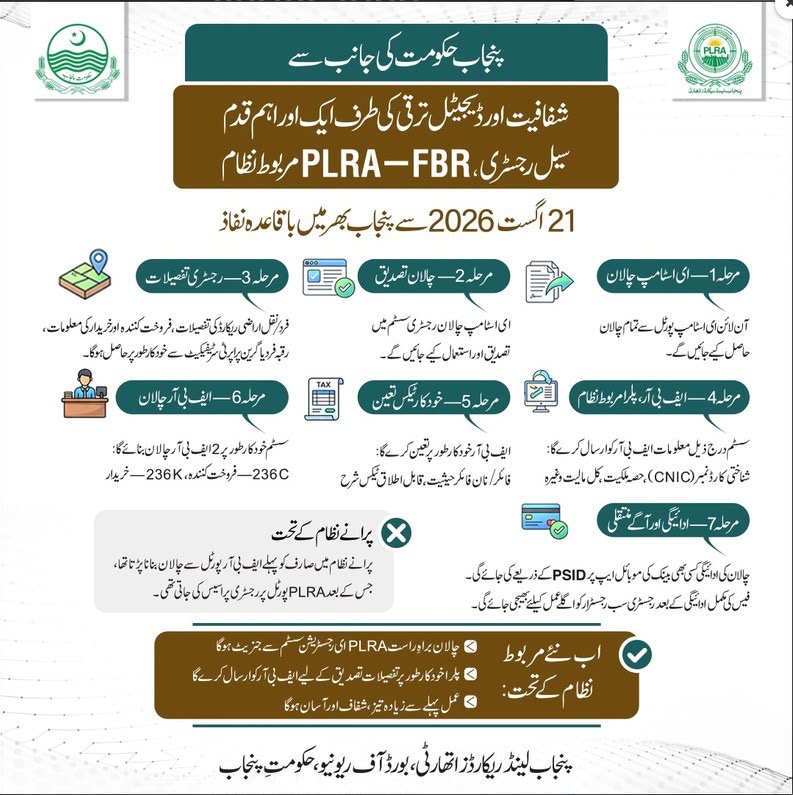
01Official Punjab Government/PLRA process infographic • preserved as source evidence
Verified figures
Seven-step integrated registry workflow
This is a buyer-friendly explanation of the official process graphic. Portal screens and required documents can vary with the transaction and service channel.
Step
Process
What the applicant should check
1
Create the e-Stamp challan
Use the official Punjab e-Stamp/registry service and verify buyer, seller and property entries
2
Challan verification
Confirm that the challan is verified and accepted by the registration workflow
3
Registry particulars
Match ownership, seller/buyer identity, property description, value and supporting record
4
PLRA–FBR data exchange
Recheck CNICs, ownership shares, declared value and transaction information before submission
5
Automatic tax determination
Confirm current taxpayer status and the legal basis of every calculated amount
6
Separate FBR challans
Section 236C challan relates to the seller; section 236K challan relates to the buyer
7
PSID payment and onward processing
Keep payment evidence; after verification the case proceeds to the Sub-Registrar
Buyer questions
Frequently asked questions.
What changed in Punjab property registry on 21 August 2026?+
The official process material describes a PLRA–FBR integrated workflow in which property and taxpayer details, tax challans and payment verification are handled within the connected sale-registry process instead of relying on disconnected manual steps.
Who pays tax under section 236C?+
The official process graphic identifies section 236C as the seller-side advance tax challan. The actual amount depends on current law, transaction value and taxpayer status.
Who pays tax under section 236K?+
The official process graphic identifies section 236K as the buyer-side advance tax challan. Obtain a dated calculation for the exact transaction before payment.
Does automatic calculation guarantee that a registry is legally clear?+
No. System calculation does not replace title, ownership, approval, dues, litigation, identity and document checks, nor does it guarantee acceptance by the Sub-Registrar.
Can the tax amount change?+
Yes. Rates, taxpayer status, valuation basis and legal rules can change. Confirm the live calculation and controlling law on the transaction date.
01
What Punjab's integrated registry system changes
The new workflow links the Punjab Land Records Authority's sale-registration process with Federal Board of Revenue checks. The objective is to reduce repeated data entry, calculate the relevant seller and buyer advance-tax challans within the connected process, verify payment digitally and move the case onward for registration after the required checks are completed.
02
What the system does not prove
A generated challan or successful PSID payment is not proof that the property's title is clean, the seller has unrestricted authority, the project or society is approved, dues are cleared or the registry must be accepted. Those are separate legal and documentary questions.
Automatic tax calculation is not a market-price certificate
Filer/non-filer status must be current on the transaction date
A paid challan does not replace title-chain and ownership verification
Society, authority, mutation, stamp-duty and registration requirements remain transaction-specific
03
Documents buyers and sellers should prepare
Before creating the challan, both parties should reconcile the official record with the sale agreement and identity documents. Incorrect CNIC, ownership share, area, property type or declared value can affect tax and delay registration.
Original CNICs and current taxpayer-status evidence
Ownership document, latest Fard or relevant digital property record
Complete title and transfer chain
Exact property description, area, ownership share and declared consideration
Society or authority NDC, dues and transfer permission where applicable
Separate written calculation of stamp duty, registration, mutation, FBR taxes and service charges
PSID challans, payment receipts and Sub-Registrar submission acknowledgement
04
Buyer action before paying token or bayana
Do not wait until registry day to discover a tax, title or identity mismatch. Ask the seller to provide the current property record and run a transaction-specific cost check first. The bayana agreement should identify who bears each tax, fee, arrear and correction cost if the digital record does not match the agreed property.
05
FPN due-diligence note
This report explains an official digital process update and is not legal or tax advice. Portal procedures, tax rates, valuation rules and registration requirements can change. Confirm the live process with PLRA, FBR and the relevant Sub-Registrar, and obtain qualified legal and tax advice before signing or transferring funds.
Verification note
Verified on 21 August 2026 against the Punjab Government/PLRA public process infographic supplied for this update and the Punjab Land Records Authority's official Registry service guide. The official material describes an integrated PLRA–FBR workflow for e-Stamp challan creation, property and taxpayer verification, automatic withholding-tax determination, separate seller and buyer challans, PSID payment and onward transmission to the Sub-Registrar. FPN has not treated the process graphic as a tax-rate notification: applicable amounts, filer status, property value, fee heads and legal eligibility must be confirmed for the exact transaction date. Information may change after publication; always obtain the latest official document before acting.
Friends Property Network is not responsible for project delays, non-delivery, possession delays, escalation or developer-imposed charges, approval changes, investment loss or developer default. Conduct independent legal, financial and technical due diligence before investing.